
SNMP for CCNA: Device Monitoring with Community Strings and Traps
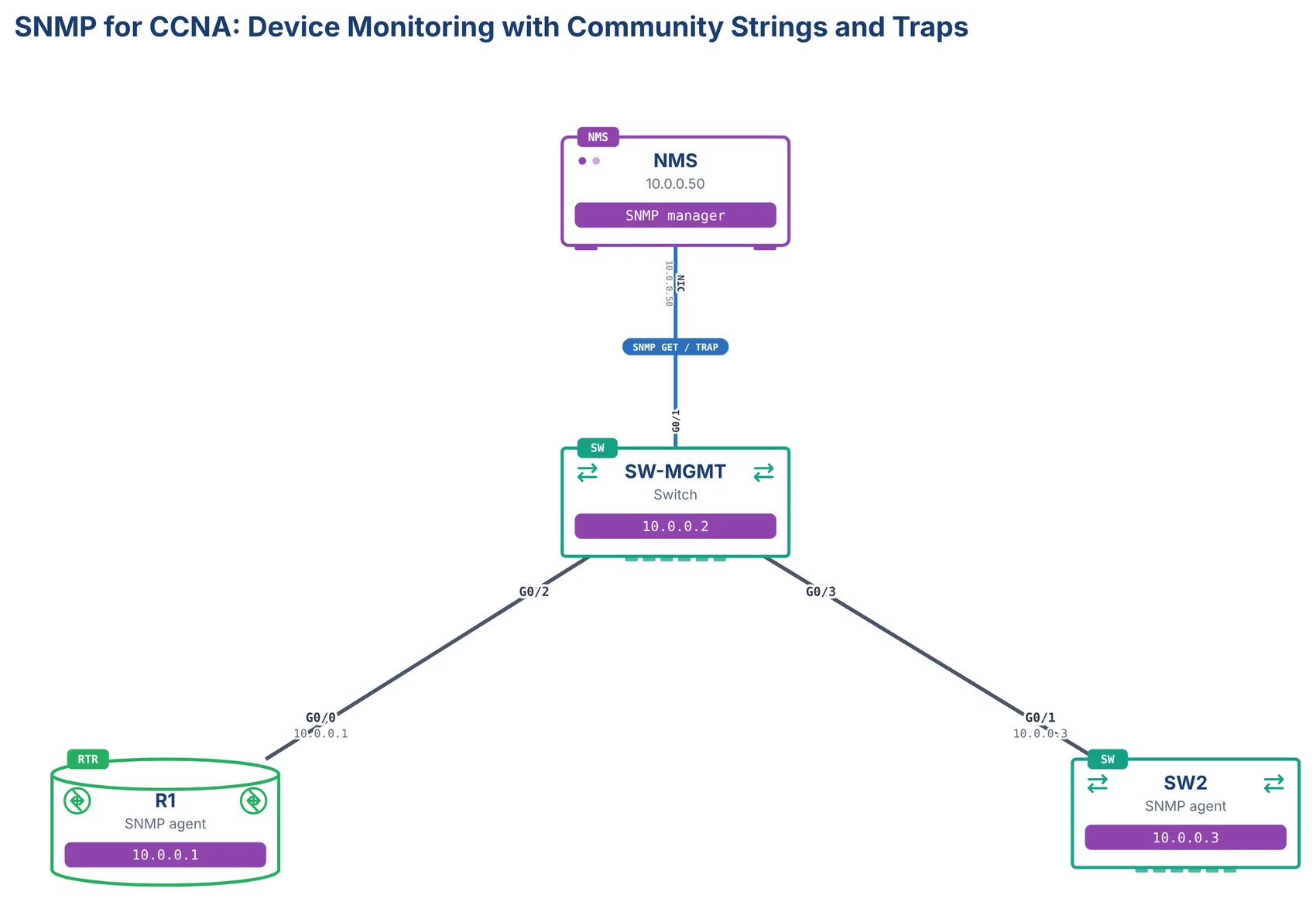
SNMP lets a management system (NMS) query and receive alerts from network devices. Each device runs an agent with an information base (MIB). It is the monitoring service the CCNA asks about the most.
Edit this template Download .json
Learning objectives
- Tell NMS, agent and MIB apart.
- Configure a read-only community and a trap destination.
- Compare SNMPv1/v2c with SNMPv3 in security.
Devices and addressing
| Device | Type | Details |
|---|---|---|
| NMS | NMS | 10.0.0.50 SNMP manager |
| SW-MGMT | Switch | Switch 10.0.0.2 |
| R1 | Router | SNMP agent 10.0.0.1 |
| SW2 | Switch | SNMP agent 10.0.0.3 |
Reference configuration (Cisco IOS)
R1
snmp-server community LECTURA-2026 ro 10
snmp-server location Sede-Central
snmp-server contact noc@ejemplo.com
snmp-server enable traps
snmp-server host 10.0.0.50 version 2c LECTURA-2026
access-list 10 permit 10.0.0.50
Verification commands
show snmpshow snmp communityshow snmp hostsnmpwalk -v2c -c LECTURA-2026 10.0.0.1 (en el NMS)
CCNA exam tips
SNMPv1 and v2c send the community in clear text; SNMPv3 adds authentication and encryption.
Operations: GET reads, SET writes, TRAP/INFORM reports events.
How to use this template
Press “Edit this template”: the editor opens with the topology loaded and ready to change (undo with Ctrl+Z). You can also copy the JSON and paste it into the editor with File ▸ Import JSON…. Then add devices, change IPs and export to PDF, PNG or SVG.
To practice, rebuild the topology in Cisco Packet Tracer, GNS3 or Cisco Modeling Labs and paste the reference configuration on each device. Addresses and names are examples: change them to create your own variants.
JSON template for the editor
This is the full diagram in JSON format. Paste it into the editor (File ▸ Import JSON…) or press the edit button to load it automatically.
Frequently asked questions
What is a MIB?
A hierarchical database of manageable objects, identified by OID.
Which ports does SNMP use?
UDP 161 for queries and UDP 162 for traps.