
PAT (NAT Overload) for CCNA: Whole LAN Behind One Public IP
PAT (Port Address Translation) lets hundreds of hosts share a single public IP, telling each session apart by port number. It is the most common Internet-exit configuration in the world and a CCNA classic.
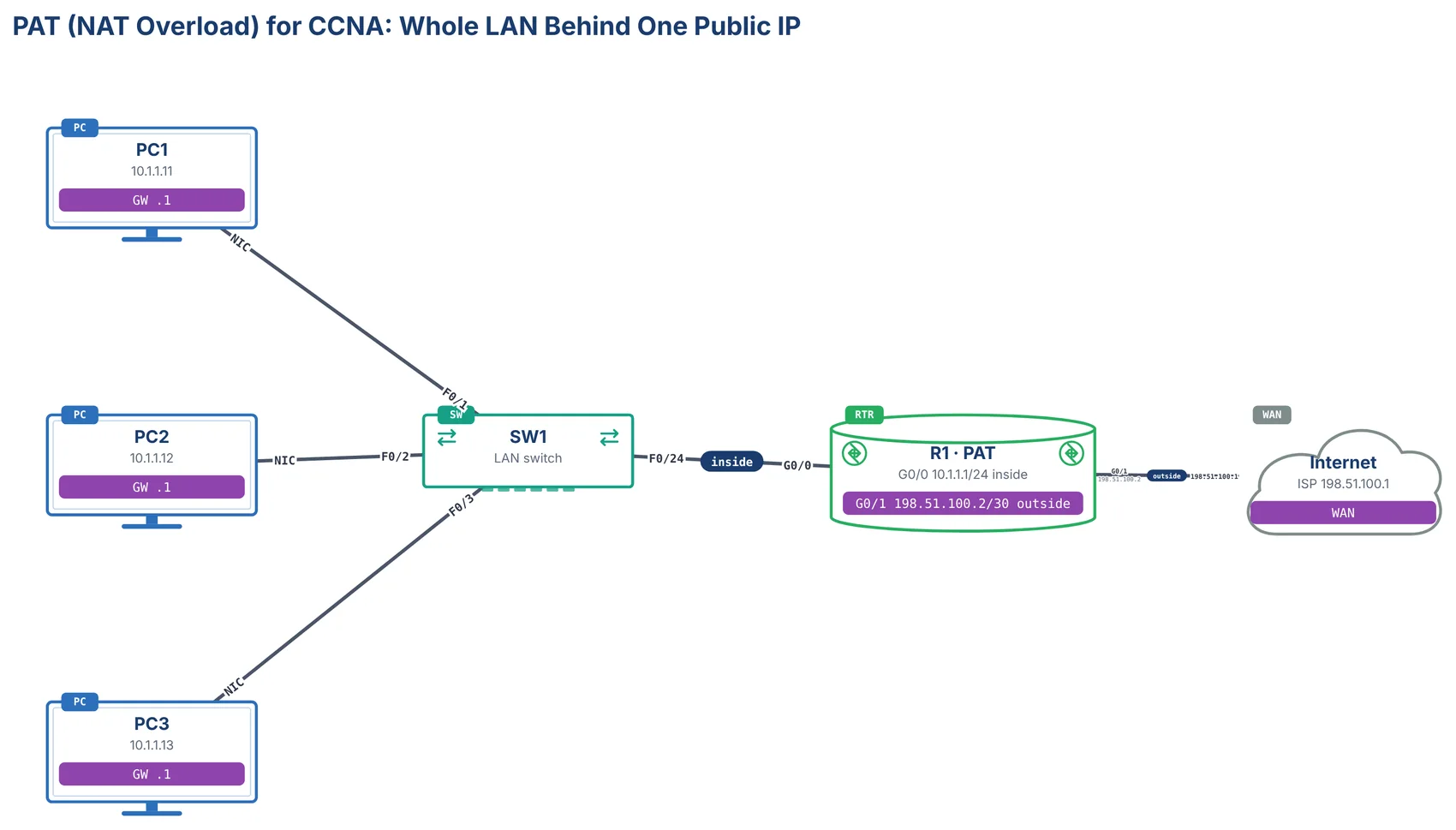
Edit this template Download .json
Learning objectives
- Configure PAT with ip nat inside source list … interface … overload.
- Understand why many sessions share one IP with different ports.
- Read the translation table with inside local and global ports.
Devices and addressing
| Device | Type | Details |
|---|---|---|
| PC1 | PC / user | 10.1.1.11 GW .1 |
| PC2 | PC / user | 10.1.1.12 GW .1 |
| PC3 | PC / user | 10.1.1.13 GW .1 |
| SW1 | Switch | LAN switch |
| R1 · PAT | Router | G0/0 10.1.1.1/24 inside G0/1 198.51.100.2/30 outside |
| Internet | Cloud / WAN | ISP 198.51.100.1 WAN |
Reference configuration (Cisco IOS)
R1
interface g0/0
 ip nat inside
interface g0/1
 ip nat outside
access-list 10 permit 10.1.1.0 0.0.0.255
ip nat inside source list 10 interface g0/1 overload
ip route 0.0.0.0 0.0.0.0 198.51.100.1
Verification commands
show ip nat translationsshow ip nat statisticsping 8.8.8.8 source g0/0
CCNA exam tips
The overload keyword is what turns NAT into PAT.
The ACL does not filter traffic here: it only defines which addresses are translated.
How to use this template
Press “Edit this template”: the editor opens with the topology loaded and ready to change (undo with Ctrl+Z). You can also copy the JSON and paste it into the editor with File ▸ Import JSON…. Then add devices, change IPs and export to PDF, PNG or SVG.
To practice, rebuild the topology in Cisco Packet Tracer, GNS3 or Cisco Modeling Labs and paste the reference configuration on each device. Addresses and names are examples: change them to create your own variants.
JSON template for the editor
This is the full diagram in JSON format. Paste it into the editor (File ▸ Import JSON…) or press the edit button to load it automatically.
Frequently asked questions
What is the difference between NAT and PAT?
NAT translates IP to IP; PAT translates many IPs to one and uses the port to tell them apart.
How many sessions does PAT support?
In theory tens of thousands per public IP, limited by available ports.